Khul’: dissolution of marriage for consideration
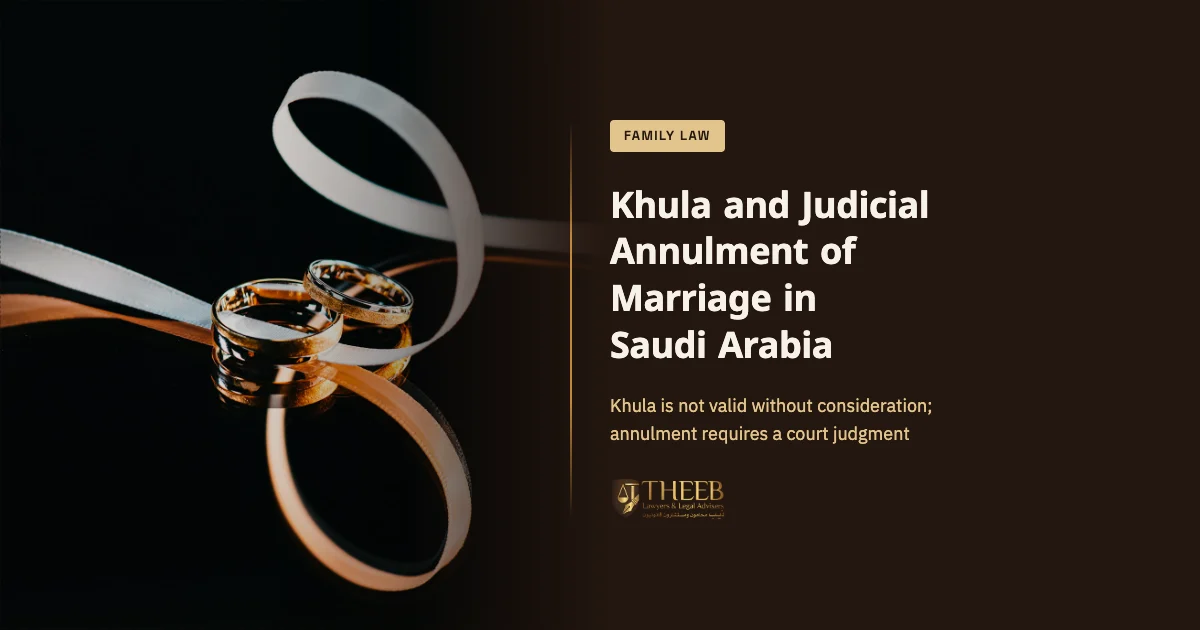
Article 95 of the Personal Status Law defines khul’ as separation between spouses at the wife’s request and with the husband’s consent, in return for consideration provided by the wife or another person.
Khul’ may validly be concluded by mutual agreement between spouses who have full legal capacity, without the need for a court judgment.
Khul’ constitutes dissolution of the marriage contract. The resulting separation is irrevocable in the lesser degree (baynunah sughra) and does not count towards the three pronouncements of divorce.
What may constitute consideration for khul’?
Article 100 provides that anything legally recognised as property may constitute consideration for khul’.
The Law nevertheless provides specific protection for children’s rights. It expressly prohibits making the waiver of any of the children’s rights, or their custody, the consideration for khul’.
If the consideration is the marriage dower (mahr), the wife is required to return only the portion she has actually received. Any unpaid portion is extinguished, even if deferred, under Article 101.
Is khul’ valid without consideration?
No. Article 99 of the Law provides that khul’ does not take effect without consideration. If a husband releases his wife by khul’ without consideration, the separation is not treated as khul’; the rules governing divorce apply instead.
This highlights the fundamental distinction between khul’ and judicial dissolution. Khul’ is based on the wife’s request, the husband’s consent and consideration. By contrast, either spouse may seek judicial dissolution on statutory grounds without the dissolution necessarily being based on consideration.
Judicial dissolution of the marriage contract
Article 103 of the Personal Status Law provides that any separation ordered by a court judgment constitutes dissolution (faskh). The resulting separation is irrevocable in the lesser degree and does not count towards the three pronouncements of divorce.
The principal grounds for dissolution regulated by the Law include:
A harmful or repellent condition
Either spouse may seek dissolution of the marriage contract on account of a harmful or repellent condition affecting the other spouse that prevents marital cohabitation. This applies whether the condition existed before the marriage contract or arose afterwards, unless the spouse seeking dissolution knew of it and accepted it by words or conduct.
Failure to provide maintenance
A wife may seek dissolution of the marriage contract if her husband refuses to maintain her or maintenance cannot be recovered from him. She may also seek dissolution if he claims that he is unable to pay the maintenance legally due to her.
Harm
Article 108 of the Personal Status Law permits a wife to seek dissolution of the marriage contract where the husband has caused her harm that makes continued marital life on an acceptable basis untenable, provided that the harm is established.
Persistent marital discord
Where harm is not established, but discord persists and reconciliation proves impossible, Article 109 regulates the appointment of two arbitrators from the spouses’ families or other persons whom the court considers capable of achieving reconciliation. Their appointment is for a period not exceeding sixty days from the date on which they are appointed.
Absence
The Law permits a wife to seek dissolution on account of her husband’s absence in the circumstances specified in the relevant provisions. The applicable periods differ according to whether his domicile or place of residence is known or unknown.
Consequences of dissolution
The financial consequences relating to the marriage dower vary according to the ground for dissolution and its timing. The Personal Status Law and its Implementing Regulations address these situations in detail, including the effect of a condition existing before the marriage contract or arising afterwards, and whether dissolution occurs before or after consummation.